Here is an unpopular truth about moving to the Amsterdam region with children: the school waitlist decides your move, not you. Every year we watch families pick a house first and a school second, then spend twelve months driving a seven-year-old across the region because the year group they needed was full. In Amstelveen, the town that exists in expat conversation almost entirely because of its schools, doing it in that order is the single most expensive mistake you can make.
The school comes first. The house comes second.
The reason families type Amstelveen into a search bar is the International School of Amsterdam, which despite the name sits on Sportlaan in Amstelveen. ISA teaches children from age 2 to 18, was the first school in the world to offer the full IB curriculum from early years through diploma, and draws students from over 60 nationalities.
Published tuition for 2025/26 ran from €18,775 to €26,950 per year depending on grade, and a first year lands around €28,000 once one-off fees are included. That is per child. It is also not the ceiling: waitlists are a fact of life, heaviest in Early Years and whichever year groups happen to be full that cycle.
The second option most families shortlist is Amity International School Amsterdam on the Amsterdamseweg, an IB school of around 430 students with published fees a few thousand euros below ISA's for most year groups. Amity is younger and smaller, which cuts both ways: shorter queues in some year groups, less of the alumni machinery.
What this means in practice is that your relocation timeline belongs to an admissions office, not to your employer's HR department. The right sequence, the one we run with families, looks like this:
- Apply to ISA and Amity before you start the housing search, even without a confirmed move date. Both will register a child against an anticipated arrival date.
- Only once you have a confirmed or strongly indicated place, target housing within a 15 to 20 minute cycle of the school. In Amstelveen that is most of the town, which is exactly the point.
- Time the lease start to the school confirmation, not the job start. A month of temporary housing is cheaper than a year of the wrong school.
- Budget the school into the housing decision. A family paying €28,000 per child per year sometimes discovers that the €600 monthly rent saving of a smaller house was never the number that mattered.
One family we worked with this spring did it in exactly this order: ISA confirmation secured from abroad, then a focused two-week search near the school. The house came together in days precisely because the geography was already decided.
The housing stock: pre-war Elsrijk to new-build Westwijk
Amstelveen's family stock splits roughly by decade. Elsrijk, directly east of the Stadshart, is the prettiest of it: 1930s brick houses in the Amsterdam School style on tree-lined streets, walkable to ISA and to the shops. It is also where asking prices push toward the top of the range. Randwijck, in the north against the Amsterdam border, trades period charm for proximity: you are minutes from Zuid and from Amsterdam's Buitenveldert.
Bankras and Kostverloren in the east offer 1960s and 70s houses at somewhat gentler prices, and Westwijk in the southwest is the newest and largest neighbourhood, full of larger single-family homes with actual gardens and its own tram stops on line 25. Waardhuizen and Middenhoven, 1980s vintage, are the value picks if you accept a longer ride to everything.
Now the uncomfortable part: this stock barely grows. Amstelveen sits under the Schiphol flight paths, and national noise rules (the LIB zones) cap new construction across much of the municipality. The town spent years trying to convert the Kronenburg office park into 4,582 homes; after a ministerial intervention in July 2025, exactly 438 student units were approved, and even that decision was under appeal by early 2026.
When a municipality this wealthy cannot build, the homes that exist are the market. Supply tightness here is structural, not cyclical, which is one more local twist on the national squeeze we unpack in our 2025-2026 rental market explainer.
The numbers reflect it. WoonPeek measured a median asking rent of about €2,650 across Amstelveen listings in June 2026, with the average near €2,900 because large family houses drag it upward. Pararius data puts the municipality at roughly €23.40 per square metre, second in the Netherlands behind only Amsterdam itself.
What Amstelveen costs against Amsterdam-Zuid in 2026
The honest comparison is not Amstelveen versus Amsterdam in general. Families choosing Amstelveen were never going to live in De Pijp. The real alternative is Amsterdam-Zuid, specifically Oud-Zuid and Buitenveldert, which offer the other credible school run to ISA. Mid-2026 asking prices, from Pararius and huurwoningen.nl listings and neighbourhood-level reporting, compare like this:
| Home type (asking, mid-2026) | Amstelveen | Amsterdam-Zuid |
|---|---|---|
| 1-2 bed apartment, furnished | €1,700-€2,400 | €2,000-€3,000 |
| 3-bed family apartment | €2,300-€2,900 | €3,000+ |
| Family house with garden | €2,500-€4,750 | €4,000+, rarely listed |
| Price per m2 (Pararius) | ±€23.40 | highest in NL |
Read the third row twice. A house with a garden is a normal product in Amstelveen and a unicorn in Oud-Zuid. That, plus the school run, is the entire case. What you give up is equally concrete: no canal at the end of the street, no spontaneous Tuesday night culture, and a town that empties out by 21:00. If the Amsterdam version of your life matters more than the garden, the Amsterdam numbers above are the price tag on it.
The Zuidas commute, precisely
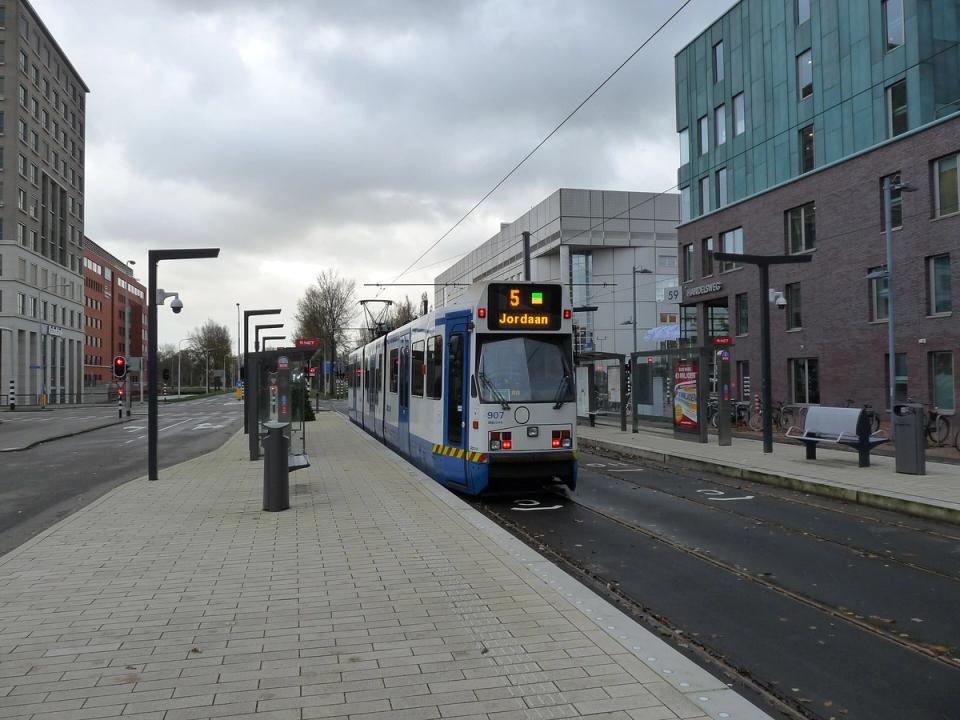
Tram 25, the Amsteltram that replaced the old metro 51, runs from Uithoorn through Westwijk and Stadshart straight to Amsterdam Zuid station. Stadshart to Zuid takes about 15 minutes; the full Uithoorn to Zuid run is timetabled at just over half an hour. Since 29 March 2026 the line continues beyond Zuid to Muiderpoort, which quietly turned it into a direct link to Amsterdam Oost as well.
Zuid station drops you in the middle of the Zuidas, so a banking or law commute from Amstelveen routinely beats one from large parts of Amsterdam proper. The catch: Amstelveen has no NS station of its own. Schiphol is about 15 minutes away, but a daily train commute to Utrecht or Rotterdam means a transfer at Zuid or Schiphol every single day.
The Japanese layer, and why it matters even if you are not Japanese
Amstelveen has been the centre of the Japanese community in the Netherlands since the 1970s, when Japanese firms opened offices around Amsterdam Zuid and their staff settled one town over. Canon, Mitsubishi and Yamaha kept posting employees here for five decades, and KLM's head office on the Amsterdamseweg added its own stream of international staff.
The visible result is a small Japanese high street scattered across town: Ishindo in the Stadshart, the Japanese-Korean supermarket Shilla at Westwijkplein, the recently opened HARRO, and Atariya just over the Amsterdam border on Kastelenstraat. The Japanese School of Amsterdam itself is, confusingly, in Amsterdam, but its families largely live in Amstelveen; the Korean School holds its classes at Amstelveen's Keizer Karel College.
Why should a Dutch-bound engineer from Bangalore or Boston care? Because fifty years of corporate postings built infrastructure every international family benefits from: landlords who are completely comfortable with foreign payslips and company lets, and a rhythm of well-maintained family homes returning to the market each summer when postings end. If you are searching in spring for an August start, that corporate churn is your best friend.
It is also a market where knowing which homes are about to come back matters more than refreshing portals; we wrote about how that off-market layer works in our guide to off-market rentals.
Who should skip Amstelveen
Singles and young couples, mostly. Amstelveen is quieter than you think, and we mean that as a warning, not a compliment. The Stadsplein has restaurants and a good cinema, and then the evening ends. Nightlife means catching tram 25 to Amsterdam and watching the clock for the ride home. If your social life is the reason you moved to the Netherlands, you will resent this town within a month.
The budget maths agrees. Amstelveen shows up in just 19 of the roughly 1,550 housing requests in our intake, with a median maximum budget of €1,500 and the middle half between €1,300 and €1,850. Those budgets are real, but they collide with a market whose median listing asks around €2,650 and whose family houses start at €2,500.
Below roughly €1,800 you are competing for a thin band of smaller apartments, the exact segment shrinking fastest as small landlords sell up. Families are only around 1 in 10 of the requests we see nationally, which tells you who Amstelveen's competition actually is: not the crowd, but a specific, well-funded slice of it.
Skip Amstelveen if: you are single and under 35, your budget caps below €1,800, your office is in Utrecht or Rotterdam and you refuse a daily transfer, or your children will attend a regular Dutch school anyway, in which case half the towns in Noord-Holland deliver the same calm for less money. Choose it if the school-first logic above describes your family, because for that specific brief there is no better-engineered town in the country.
If you want help sequencing the school confirmation, the lease start and the actual search, get in touch; this is the exact type of relocation we run most often for families.
Need help with your relocation?
Book a free 30-minute consultation with one of our relocation experts. No strings attached.
Book free consultationFrequently asked questions
Do I need to secure a school place before renting in Amstelveen?
How long is the commute from Amstelveen to the Zuidas?
Does Amstelveen have its own train station?
How much does it cost to rent a family house in Amstelveen in 2026?
Why does Amstelveen have such a large Japanese community?
Is Amstelveen a good choice for single expats?
By Claire Krechting